1
Shoppers do not know the exact product name
In a real catalog people search by the job, not by SKU: a compact fridge for a small kitchen, a sofa for a narrow living room, food for a sterilized cat.
Reads the query by meaning, searches the product catalog and finds the item even when the shopper uses their own words.
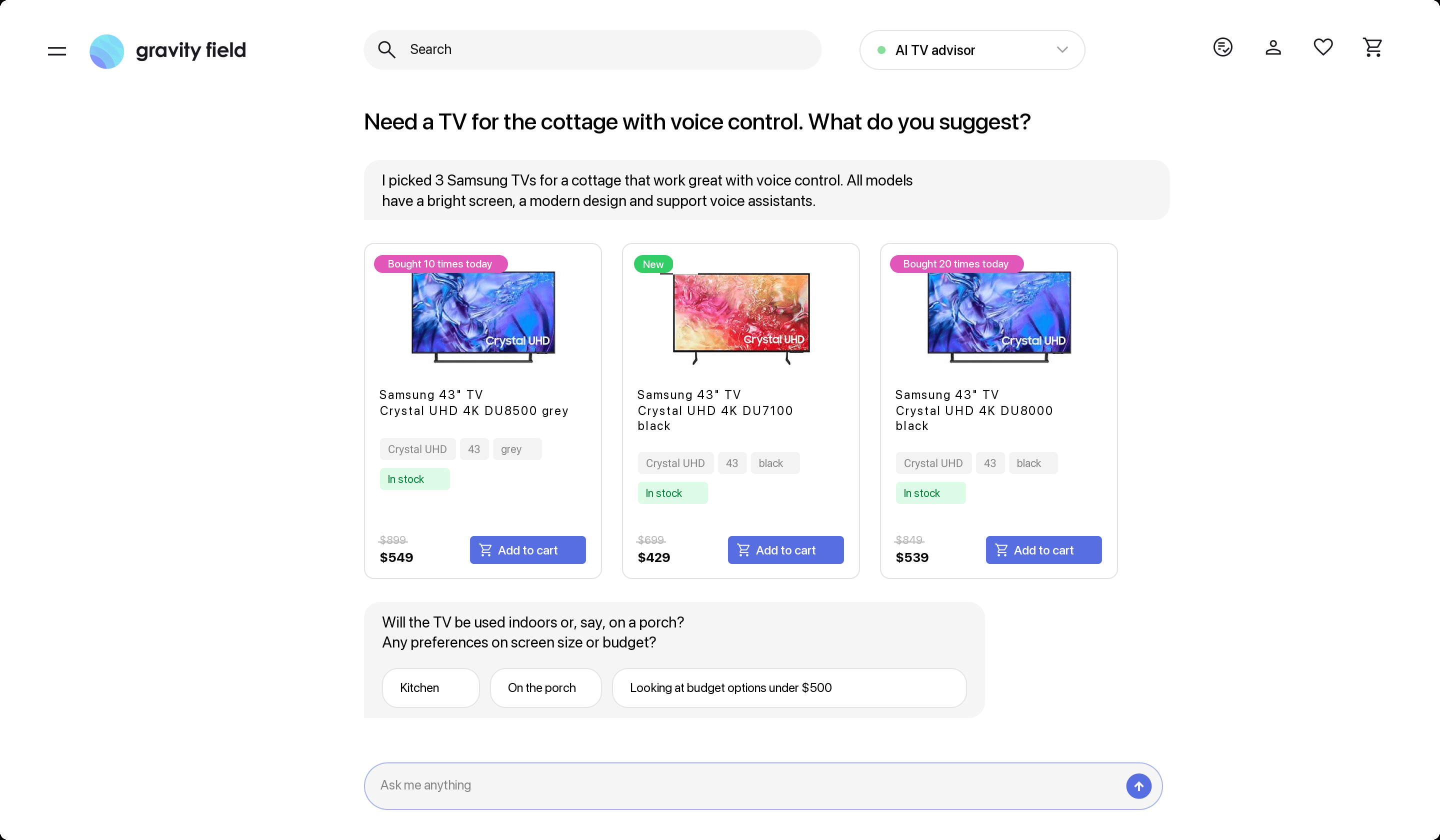
Smart search for online stores finds products by meaning, not by keyword match
Gets shoppers to the product page faster
Works as semantic search for ecommerce and search across the product catalog
Trusted by
In a real catalog people search by the job, not by SKU: a compact fridge for a small kitchen, a sofa for a narrow living room, food for a sterilized cat.
A wide assortment, complex specs and free-form queries. Classic search across a product catalog often cannot read them as an intent to buy.
Large retailers do not need abstract improvements, they need a clear effect: more product page clicks, add-to-cart events and orders.
The point is not to show products, but to use catalog search so the shopper reaches a choice and a purchase faster.
Parses the free-form query, pulls out the constraints and does not make the shopper guess the catalog vocabulary.
Results take in the meaning of the query, product attributes, assortment, stock and store rules: that is how semantic search for ecommerce works.
A good search result is not just a list: it is product page clicks, add-to-cart and higher conversion.
Example query
Looks past the word fridge at the use case, the dimensions and the installation type.
Example query
Takes size, purpose and color into account so the shopper is not lost among dozens of similar models.
Example query
Reads the compound query and leads to relevant products without manual filter work.
Useful where the choice depends on several parameters at once and filters can no longer cope.
Catalog, attributes, stock and display rules can all affect ranking and matching.
You can return a list and also highlight why these specific products fit the shopper's task.
Watch product page clicks, add-to-cart and the contribution of search traffic to revenue.
Short answers to the questions that come up most often before launching AI product search.
Smart search is product catalog search that reads not only the exact words but the shopper's task. It finds relevant products from free-form queries and moves the shopper to the product page faster.
AI product search interprets queries by meaning, not only by exact words. It finds products when the shopper describes the job in their own words.
Keyword search mostly depends on matching words in the title or the description. Semantic product search takes in the meaning of the query, the attributes, the context and the constraints, so it handles complex shopper wording better.
Standard site search depends on an exact word match. AI search handles long, context-heavy queries better and helps in a wide catalog where the choice is complex.
When the assortment is large, products are hard to compare, and shoppers state a need rather than an exact SKU.
Yes. It makes sense to start with one search scenario and check the effect on product page clicks, add-to-cart and revenue.
The key metrics are search result CTR, product page clicks, add-to-cart and revenue from search sessions.
We review your assortment, show free-form query examples and propose a clear first step for launching AI search.